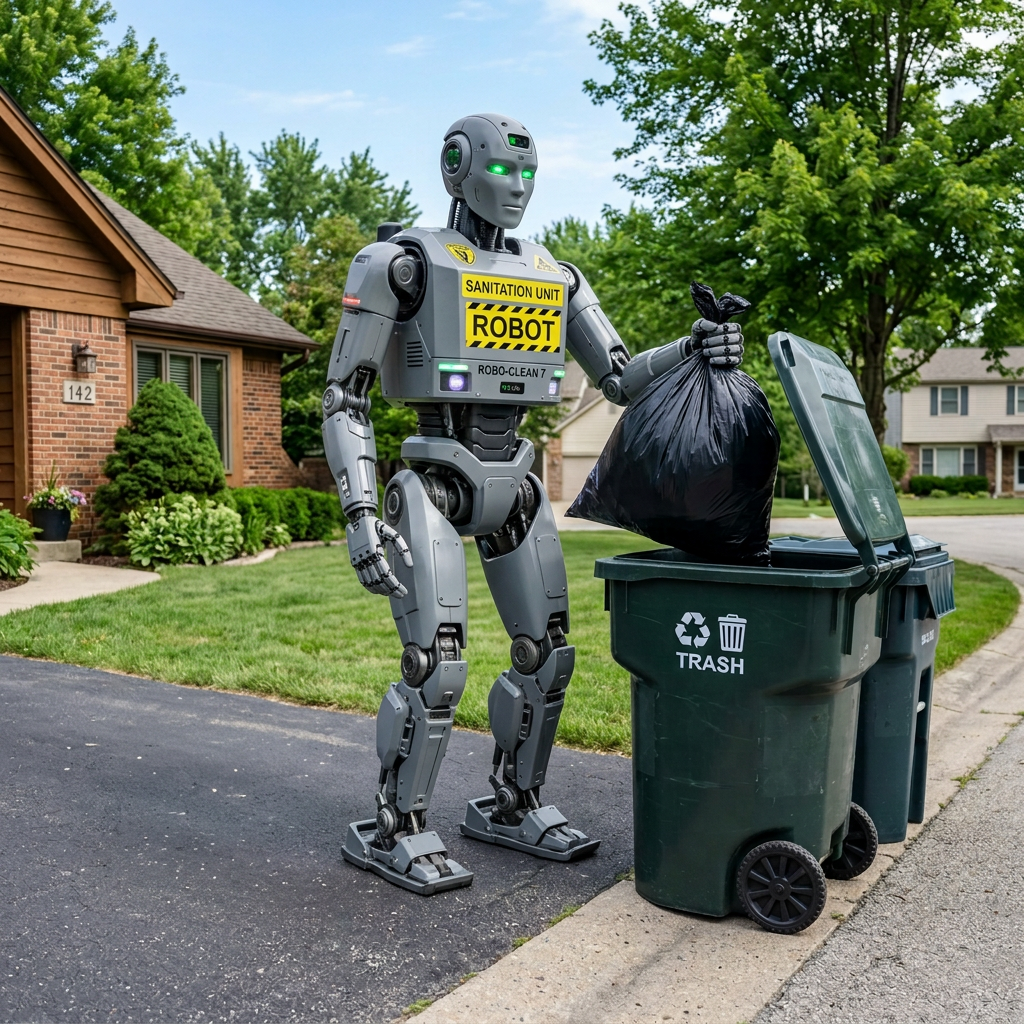
Insisting that AI needs a finished road before it can be useful ignores the machine that lays the tarmac.
Nearly nine in ten respondents to McKinsey’s latest State of AI survey report regular use of AI in at least one business function. Nine in ten, and yet in most meetings the word is still used in the singular, as though the organisation had bought one thing and the only open question was whether it works.
This week I heard the standard objection, delivered with some heat: AI cannot be used without good foundations. Garbage in, garbage out. It is a fair thing to say about one kind of AI, and I don’t want to wave it away. If you point a model at your data to forecast demand or score credit risk, the quality of what goes in decides the quality of what comes out. Gartner found that 63% of organisations either don’t have, or aren’t sure they have, the right data management practices for AI (a survey of 1,203 data management leaders, July 2024), and it predicts that through 2026 organisations will abandon 60% of AI projects unsupported by AI-ready data. The objection is right about the AI that consumes data.
But garbage in, garbage out is a statement about a consumer. It says nothing about the AI that produces, repairs or polices the data. Take the contracts, emails, PDFs, call notes and engineering reports where most of an organisation’s knowledge actually lives, and where none of it fits in a table. Gartner told delegates at its Orlando data and analytics summit in March that by 2027, spending on multistructured data management will account for 40% of all spend on data management technology and services. Nobody is going to key those documents into rows by hand. The model that reads a contract and returns the renewal date, the notice period and the liability cap is not waiting for a clean foundation. It is building one.
The same is true of the AI that notices “J. Smith”, “John Smith” and “Smith, J.” are one customer, or that a supplier code quietly changed format in March. Gartner now publishes an entire Magic Quadrant for Augmented Data Quality Solutions, a market it describes as a fundamental shift in solving data quality issues using active metadata, AI and graph technologies. Its analysts predict that by 2027, AI assistants and AI-enhanced workflows in data integration tools will cut manual intervention by 60%. Whether that figure lands or not, the direction is clear: the garbage is increasingly being processed by the thing everyone says can’t touch it.
This is also why “do we have good foundations?” is the wrong question. Gartner’s own advice on AI-ready data is that it is “not ‘one and done’”: a practice whose infrastructure needs constant improvement as use cases change. Foundations are not a stage you pass through before AI arrives. They are something that has to be maintained continuously, and the maintenance is now partly automatable.
There is a fourth AI, and this is where the sceptic’s instinct deserves real credit. The same technology manufactures garbage at industrial speed. In January, Gartner predicted that by 2028, half of all organisations will adopt zero-trust data governance because of the growth in unverified AI-generated data. In the words of its Managing VP Wan Fui Chan, “Organizations can no longer implicitly trust data or assume it was human generated.” So one label now sits on the machine that cleans the data and the machine that contaminates it. The technology is identical. What differs is where you point it, and who is watching.
Which raises the awkward question of why, if AI can do so much of this work, it so rarely gets pointed at the garbage. Informatica’s CDO Insights 2026, a survey of 600 data leaders, found 57% cite data reliability as a key barrier to moving AI from pilot to production. The same survey found that 65% of those leaders believe most or nearly all of their employees trust the data they use for AI. Gartner’s research adds that 59% of organisations don’t measure data quality at all. So: data reliability is the barrier, the data is trusted, and nobody is measuring it. That is not a technology gap. It is an ownership gap.
I’ve spent the better part of two decades cleaning up after data that was born broken, and it was rarely the data’s fault. Almost always it was a process upstream that nobody owned: a free-text field, a form nobody redesigned, a definition Finance and Sales quietly disagreed about. No tool, old or new, fixes a process that has no owner. What has changed is that the tools can now do the tedious part of the fixing, which removes the last good excuse for not knowing who is responsible.
So before asking whether the foundations are good enough for AI, ask which AI, doing which job, and who owns the process that keeps making the mess. The answer to the first two is a technology decision. The third never was.
Garbage in, garbage out was never a law of AI. It is a description of what happens when nobody owns the bin.
Sources: McKinsey, “The State of AI” (25 August 2026; 1,719 respondents in 97 countries) for regular AI use across business functions; Gartner, “Lack of AI-Ready Data Puts AI Projects at Risk” (26 February 2025) for the 63% survey figure (1,203 data management leaders, July 2024), the 60% abandonment prediction and “not one and done”; Gartner Data & Analytics Summit 2026, Orlando, Day 2 highlights (10 March 2026) for multistructured data spend; Gartner, “Data Quality: Why It Matters and How to Achieve It” for augmented data quality and the 59% who don’t measure data quality; Gartner, Magic Quadrant for Augmented Data Quality Solutions (2026); Gartner, “Predicts 2025: 4 Ways AI Will Disrupt Data Management Markets and Solutions” (2025) for the 60% reduction in manual intervention; Gartner, “Gartner Predicts by 2028, 50% of Organizations Will Adopt Zero-Trust Data Governance as Unverified AI-Generated Data Grows” (21 January 2026); Informatica, “CDO Insights 2026” (27 January 2026; 600 data leaders).
Suggested category: Data and Artificial Intelligence (secondary: Entropy Management)
Mode: Argument Essay.
Alternative titles: “The Many AIs: Why ‘Garbage In, Garbage Out’ Is Only Half the Sentence” / “The Bin Problem: Who Owns the Garbage Before AI Does?”
Facts to check before publishing:
- The “60% reduction in manual intervention by 2027” prediction comes from Gartner’s Predicts 2025 report, which is paywalled. I verified it only through a secondary blog quoting the report. Confirm against the primary source or cut that sentence.
- The McKinsey figure was read from McKinsey’s State of AI page, which currently carries the 25 August 2026 edition (1,719 respondents, fieldwork May-June 2026). Check the “nearly nine in ten” wording and edition date before publishing.
- The 59% “don’t measure data quality” figure is on Gartner’s data quality topic page without a stated survey date. Worth confirming the underlying survey, or softening to “Gartner’s research suggests.”
- I couldn’t retrieve the Magic Quadrant’s own page. Vendor press coverage places the 2026 edition around mid-February 2026; the “fundamental shift” wording is from Gartner’s data quality page, not the MQ itself.
- The personal aside is my extrapolation from your stated background. Swap in a real example (a specific process, a specific field) if you have one; it will land harder.
- I left out the widely repeated “80% of data will be unstructured by 2025” (attributed to IDC) because I could only find it secondhand, without report name or date.


Leave a Reply